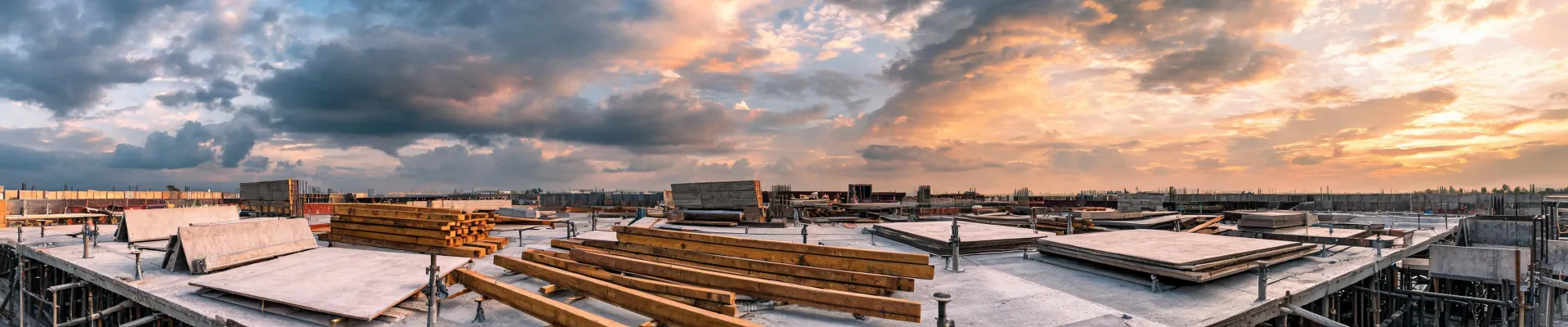
If you've ever had a formwork delivery arrive with one critical dimension off, you know the sinking feeling. I had it on a Tuesday, on two pallets shrink-wrapped so tight they looked almost clean.
I'm a quality/compliance manager at a construction supply distributor. I review every inbound formwork order before it gets released to contractors—roughly 35 deliveries a month. In Q1 2024, I rejected 11% of first deliveries because of spec mismatches. This one nearly made it.
Here's the background. A general contractor we'd worked with before was pricing a 14,000 sq ft concrete structure. They asked us for a concrete formwork wholesale quote. We put together a package of Doka formwork systems: H20 beams, shoring frames, tie rods, pipe struts, and the usual doka formwork accessories. It also included the shoring systems and scaffolding components needed for the perimeter work. The quote was solid.
But the client's procurement person had seen a lower number from someone else. “Can you match this? Or source a similar product?”
Our management, trying to keep the account, said yes. They found a broker offering H20 beams and formwork accessories at roughly 30% below our Doka price. The samples looked right. The paperwork looked right. (The production quality did not.) So they placed a trial order. That's the order sitting in my yard.
The reason we push Doka formwork in the first place isn't brand loyalty. It's that system formwork comes with an engineering trail: dimensions, load tables, compatible accessories, and replacement parts that are meant to work together. When you buy unbranded substitutions, you're buying a hope and a brochure.
What the tape measure found
My job isn't to be the hero. It's to catch problems before they become someone else's problem. So I opened the shrink-wrap. I didn't do anything fancy—just took a tape measure, a scale, a straightedge, and a Doka concrete formwork catalog.
First red flag: the H20 beams. An H20 beam is a specific thing. The “20” means 20 cm deep; the “H” profile has 8 cm top and bottom flanges. The Doka H20 beams we stock are consistently 200 mm high with 80 mm flanges. These measured 193 mm high, and the flange width varied from 77 mm to 81 mm on the same pallet. In timber, that's not a tolerance issue; that's a different geometry.
Second red flag: the steel pipe struts. The paint hid a lot, but under it I found weld spatter and a few welds that stopped short of the joint. The wall thickness measured 3.9 mm instead of the 4.5 mm on the spec sheet. A pipe that fails under concrete load doesn't bend slowly. It buckles. There's no warning. (I've seen the photos.)
Third red flag: the tie rods. The threads looked okay from a distance, but the actual diameter was inconsistent. When I ran a nut along the thread, three out of ten stopped halfway. That meant dirt, damaged threads, or a coating problem. None of those belongs in a concrete formwork system. The thread is what carries the load.
I also weighed a sample of the pipe struts. The brochure said 18.5 kg per piece. The batch averaged 16.1 kg. That was the moment I stopped being polite about it.
I wrote it up and sent management a one-word recommendation: do not release. My boss called me into his office. He wasn't angry; he was under pressure. The GC had a pour schedule. The freight bill was already paid. The client was expecting a price break.
I went back and forth for a week. The cheap lot would have helped us close the sale. The Doka lot was more expensive but came with published load tables, known compatibility between accessories, and a manufacturer that stands behind the product. On paper, the cheap lot made sense. My gut said no. I'm not usually a gut guy. But the measurements were on my side, and I had a warehouse full of evidence.
We rejected the lot. The broker argued, then disappeared. We ate the freight cost and looked like the expensive option again.
The phone call I didn't expect
Then came the surprise. Not the one you'd expect—not a customer saying “we told you so.” The client called us two weeks later. They had found another budget-friendly formwork source, saved some money, and poured a wall. One of their H20 beams cracked under load, the formwork blew out about 8 feet of wall, and the concrete had to be broken out and re-poured. The cleanup and rebar repair cost them roughly $21,000, plus a 3-week delay.
They saved maybe $6,000 on that initial order. The rework was $21,000. The math isn't complicated.
The client didn't ask for a post-mortem. They asked how fast we could deliver a full Doka system. We had it on site in four days. The re-pour went clean. The project finished before the revised schedule.
Look, I'm not saying every non-Doka formwork system is unsafe. There are plenty of engineered alternatives—steel frames, engineered timber, aluminum systems—that perform well when they're manufactured to their own specifications. The problem is when someone sells an unbranded “equivalent” and nobody verifies that it actually matches a known spec. That's how formwork fails. (And sometimes it takes a wall with it.)
How to choose formwork systems for wholesale: what I learned
So if you're trying to figure out how to choose formwork systems for wholesale, here's what I'd tell you.
- Compare systems, not piece prices. A lower H20 beam price looks good until you discover it doesn't fit the braces and waler systems you already own. Check the full concrete formwork catalog for compatibility.
- Measure. Don't trust labels. A caliper, a tape, and a scale catch a surprising number of issues before they cause a pour failure. H20 beams have defined geometry—EN 13377:2002 isn't vague.
- Ask for a sample batch and inspect it like you're paying for it. Actually, you are paying for it, one way or another.
- Look for published load tables. If a supplier can't or won't provide them, that's a red flag. Doka publishes system data for good reason.
When we quote a Doka formwork wholesale package, we include the accessories that make the system work: H20 beams, pipe struts, shoring frames, tie rods, wing nuts, aligning couplers. The project doesn't stand on panels alone. (The cost is the whole system.)
Every component has to match the Doka concrete formwork catalog before it leaves our dock. No exceptions. That rule came directly from this incident.
Also, no catalog replaces an engineered check. Pour rates, concrete pressure, wall heights, weather—all of that affects what system you need. If a supplier promises a universal answer without asking about your site conditions, walk away.
The most frustrating part? The same substitution game keeps happening. You'd think written specs would prevent it, but interpretation varies wildly. “Equivalent” is a dangerous word. Equivalent to what? Who verified it? Under what load test?
In my experience reviewing roughly 700 deliveries over the past four years, the lowest quote has cost us more in about half the cases. Not always in failures—sometimes in delays, damaged reputation, and extra coordination. But it adds up.
This approach worked for us, but our situation is specific: we're a mid-size distributor with predictable order volumes. If you're a large GC with your own QA/QC team, your verification process should be even tighter. If you're a small contractor, don't skip it just because you're in a hurry. The five minutes with a tape measure are cheaper than a formwork blowout.
Doka formwork systems aren't always the lowest quote. I won't pretend they are. But the total cost—published specs, system compatibility, spare parts, predictable behavior—is usually better. That's the conversation I now have with every wholesale client. I'd rather lose an order on price than watch someone save 15% and pay triple in the field.