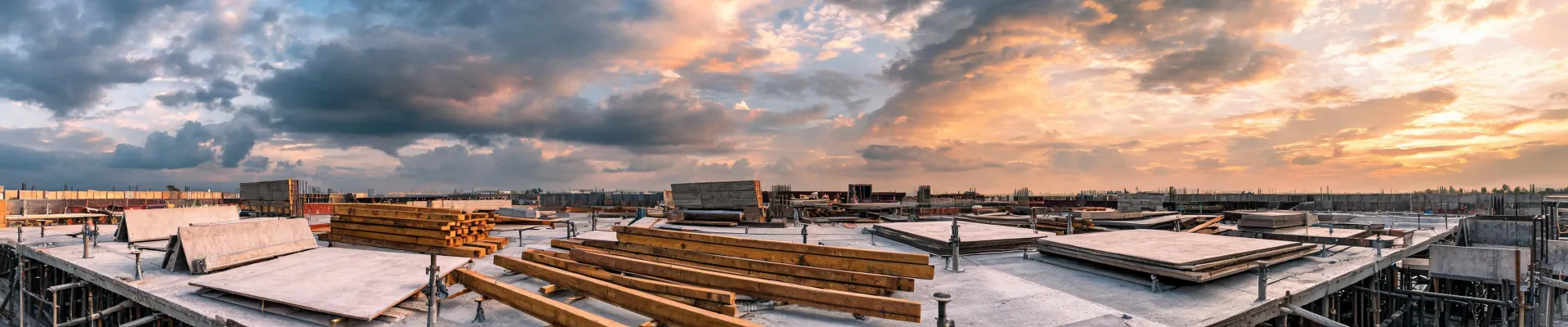
September 2022, and a 1,347-Line Doka Formwork Material List
A GC I'd worked with for four years sent over a Doka formwork material list on a Thursday afternoon. It was for a 14-story residential project — wall formwork, some bulk shoring systems, and roughly 180 meters of scaffolding.
The list itself was already a mess. It came in as a single Excel tab, 1,347 lines, and honestly about three of those lines were basically unusable:
"H20 beam — approx 3.3m" — no grade, no length tolerance.
"Tie rod w/ wing nut" — no diameter.
"Grille panels — per Doka standard" — which is a phrase that means absolutely nothing when you're pricing a bulk order.
I sent it out to two concrete formwork distributors.
The first one, a warehouse out of Southern California, came back at $68,200. Thirty-day terms. Freight on top. The quote itself was three paragraphs long and didn't mention certifications once.
The second one, our usual Ohio supplier, came back at $76,700. Attached to their quote was an EN 13377 certificate for the H20 beams, a locked three-week lead time, and a small note offering 3% spares on connectors.
Eight thousand five hundred dollars apart. On unit price, the first one was about 11.1% cheaper.
I went with the first one.
That was the last time I compared formwork suppliers by unit price.
The First Container: A Missing Stamp and a Bad Feeling
Three weeks later, the first container landed at our yard. Within about forty minutes of the doors opening, the warehouse manager called me.
Part of the shipment — I want to say around twelve pieces, though I might be misremembering the exact count — was H20 beams with no EN 13377 stamp on them. A couple had visible twist. EN 13377 is the standard that actually defines what an H20 beam is: the strength class, the cross-section, the tolerances. A beam missing that marking isn't just "uncertified." It's an unknown quantity under load, and if you're pushing fresh concrete against it, that's not a paperwork problem.
The lengths were off, too.
The list said "approx 3.3m." The crew had already laid out their wall runs assuming 3.3. A few of the beams that arrived were 3.0. Some were closer to 3.2. Close enough for a rough layout. Not close enough for system formwork.
Then the second container came in that same week — 180 grille panels. The fabricator had used what I'd call "close enough" spacing instead of Doka's actual connection geometry. Our yard guys spent half a day trying to clip one panel into the next before they figured out why nothing fit.
And then the tie rods.
Metric thread.
Our client's anchors were imperial.
I got the video from the site carpenter — a guy who's been doing this for twenty years. He just looked at the camera, said "this system won't go together," and turned the phone toward a rod that would not thread.
I watched that video twice. Then I called the Southern California warehouse.
"We Shipped to the Spec You Sent Us"
Their answer was that they shipped to spec.
The spec was a bad Excel list that I forwarded without cleaning. Contractually, they owed us nothing. We sent them vague requirements. They delivered the cheapest interpretation of vague requirements.
The negotiation got us some credit back, but not much.
They took back the unmarked beams and re-ran them. That was a three-week — or rather, closer to four-week, when you count the rework cycle — turnaround. The site had already poured footings. The wall formwork positions were just sitting there.
I called the Ohio supplier.
They had roughly 60% of what we needed in stock, matching spec. The remaining 40% came from another warehouse — air freight, which is its own kind of expensive.
What the Final Invoice Actually Looked Like
When everything was settled, the numbers looked like this:
- Original order: $68,200
- Return freight and rework on the bad H20 beams: $2,900
- Emergency restock from the Ohio supplier, including air freight: $14,100
- Extra site labor (two days of standby, then partial return to work): $3,400
- Nine days of schedule slip, valued at the GC's daily coordination cost: $3,000
Total: $94,600.
The quote we thought was expensive was $76,700.
So the 11% we saved on unit price turned into $17,900 in extra cost. And that's just the plane-ticket math. It doesn't count the hours I spent on the phone, or the fact that I had to apologize to a client who trusted me.
From the outside, it looked like the cheaper supplier was just more efficient. The reality is that some costs were hidden — pushed past the quote, into returns, rework, air freight, and site days that shouldn't have been lost.
Everything I'd read about formwork procurement said unit price was the number to optimize. In practice — for system formwork, specifically — that's backwards. You're not buying beams and panels. You're buying the fact that the beams and panels work together on site.
The Review I Ran the Following Week
The Monday after, I pulled the whole team into a conference room for four hours to take apart what happened. The conclusion wasn't "the buyer screwed up." It was "we don't have a shared pre-check."
I spent the next six months building one. It's basically a document now that every Doka formwork material list has to clear before it goes out for quotes. Here's the part of it that has actually saved us.
1. Lock down the grade — not just the size
"H20" is not a dimension. It's a strength class, defined under EN 13377. If your RFQ says "H20 beam" with no standard reference, no length tolerance, and no wood grade, you're inviting the supplier to interpret the cheapest version of H20 they can source. Get documentation, and check the stamp on arrival.
If you're designing for lateral pressure on vertical formwork, the fresh concrete pressure assumptions matter — that's where references like ACI 347 or, for European projects, DIN 18218 come in. You don't get to skate past those on a large pour.
2. Every accessory line gets cross-checked against the connection system
Tie rods, pipes, grille panels, wing nuts, connectors — they live and die on millimeter fit. Metric versus imperial, panel pitch, pipe wall thickness. If one thing is off, the whole run jams. We stopped trusting client-provided lists and started cross-referencing every SKU against our own system catalog before we send questions back.
3. Do the delay math before you compare prices
I'm in the building materials world, so I'll use our numbers. If a day of site standstill costs somewhere between $1,500 and $2,500, then a realistic six-day delay risk is a $9,000–$15,000 exposure. That single figure reorders every quote on the page.
My TCO sheet now looks like this:
- Unit price × quantity
- Freight + customs + clearance
- Certification and testing
- Spares allocation (usually 3%–5%)
- Rework and return freight exposure
- Estimated delay days × daily site cost
The number on the top of the quote is never the number at the bottom.
4. A vague material list is a contract that favors the supplier
When your own spec says "approx," "standard," or leaves a column blank, that vagueness favors whoever is quoting you, not you. Write it out. Two extra hours on the front saves six weeks on the back.
And one more thing I had to unlearn: "local always responds faster" came from a time before modern freight networks and well-run overnight warehouses existed. A disciplined remote distributor can beat a disorganized local one on turnaround, every time. Response speed is a function of process, not of distance.
Bottom Line
Oddly enough, this whole mess left me with a better opinion of formwork systems manufacturers and serious distributors, not a worse one. The Ohio supplier's quote wasn't padded. It included the certificate, the locked lead time, and the spare allowance because those things are the product. The cheap quote sold me a list. The other one sold me the fact that the list would go together on site.
If you're crawling through a concrete formwork distributor buying guide right now and trying to compare quotes on a bulk shoring systems or Doka accessories order, my advice is boring: figure out what a lost day costs you, then look at the prices. On the job I just described, the cheap quote didn't survive day one.
To be fair, their pricing was competitive — for the spec they were handed. But the spec they were handed was broken, and that's on me.
The pre-check list is still on my desktop.
The file is called pre-check-v7-FINAL-reallyfinal.xlsx.
"Reallyfinal" turned out to be a lie. That's fine. So was the 11%.